
Immigration Solutions For Families
Families that want to Immigrate to Canada often struggle with lack of clarity on the right pathway for their family.
Each family's situation is unique and their goals are unique.
Most want to immigrate for a better career or a better future for their children.
Family Immigration Pathways
Direct Permanent Residency
This is the most preferred route for most applicants.
Most applicants who get permanent residency with family directly from their home country, either go through the skilled professional route, spousal sponsorship by their spouse in Canada or the Investment/Entrepreneur PR routes.
Children are mostly included in such applications.
Work in Canada with family
If you have a job offer from a Canadian employer, you can get a work permit to work with the employer.
It's usually a closed work permit that allows you to work for that employer. In addition to that, your spouse gets an open work permit, and your children get to study in Canada for free.
Study in Canada with family
Popular option for professionals who are married and/or have children. Prepare your PR plan, if that is your end goal, while you prepare your study applications.
Family study visa means you study in Canada, your spouse gets an open work permit to work, and your children study for free in Canada.
Most people use the Express Entry or a suitable PNP pathway to finally get permanent residence and stay in Canada.
Visit Canada
Visit canada by yourself or with your family as a tourist or as a business visitor.
You cannot work on a visitor visa in Canada.
Frequently Asked Questions (FAQs)
Yes. Your spouse or common-law partner and dependent children may accompany you through an eligible Canadian immigration program, provided they meet its requirements. For permanent residence, eligible family members can generally be included in your application for a temporary move, their permission to work, study, or visit must be assessed separately.
Yes. Under many permanent residence pathways, one person applies as the principal applicant and includes their eligible spouse or common-law partner and dependent children. This does not mean every relative can be included: parents, in-laws, and siblings are not accompanying dependants and may need a separate immigration or sponsorship pathway.
Your eligible dependent children can receive permanent residence if they are included, assessed, and approved as accompanying dependents they do not receive PR automatically because you do. Children generally qualify as dependents if they are under 22 and do not have a spouse or common-law partner; certain older children may qualify if they have depended financially on their parents since before age 22 because of a physical or mental condition.
The required amount depends on your immigration program and family size there is no single proof of funds requirement for every family immigration application. For Express Entry programs that require settlement funds, family size includes accompanying and non-accompanying dependants, and the minimum amounts are updated annually. Check the current IRCC requirement before applying rather than relying on an older published figure.
The timeline depends on whether your family applies through economic immigration, family sponsorship, or a temporary residence pathway, as well as the completeness and complexity of the application. Additional background checks, medical assessments, custody questions, or requests for documents can extend processing. Use IRCC’s current processing-time information as an estimate, not a guaranteed arrival date
Depending on your program, documents may include passports, marriage or relationship evidence, birth certificates, education and employment records, language test results, proof of funds, police certificates, and medical examination records. The exact requirements vary by application type and family circumstances, so follow the official document checklist for your selected pathway.
Consider applying directly for permanent residence if you already meet a suitable program’s requirements; otherwise, compare whether a genuine work or study plan fits your qualifications, budget, and long-term goals. Before choosing a temporary route, confirm each family member’s eligibility: a spouse’s open work permit is subject to additional conditions and is not automatically available to every worker’s or student’s partner.
A medical condition does not automatically mean refusal. IRCC assesses whether a condition creates a danger to public health or public safety, or where applicable an excessive demand on health or social services. Sponsored spouses, common-law partners, and dependent children have an exemption from the excessive-demand assessment, but that exemption does not automatically apply to a spouse included in an economic immigration application. The immigration category and medical assessment therefore matter.
There is no single best program for every family. A useful assessment compares your education, language ability, work experience, available funds, job opportunities, and family circumstances against the requirements of available pathways. Potential options include Express Entry, provincial nominee pathways, and family sponsorship where an eligible sponsor exists the strongest choice is the pathway whose requirements your family can clearly meet and document.
Yes, but not every immigration refusal carries a right of appeal. Certain family sponsorship refusals can be appealed to the Immigration Appeal Division, while eligibility and restrictions depend on the case. A fresh application or a legal challenge may require a different approach, so have the refusal letter reviewed promptly before deciding what to do next.
Incomplete forms, missing documents, unpaid fees, inconsistent information, and slow responses to IRCC requests can cause problems background checks and unresolved adoption, divorce, or custody matters may also delay processing. To reduce avoidable issues, follow the program-specific checklist, declare all family members, submit complete supporting evidence, and respond to requests within the stated deadlines. A complete application helps prevent unnecessary delays, but it does not guarantee approval or a fixed processing time.
Why Legal Expertise Matters in Family Immigration
Canadian immigration is not simple. IRCC processes applications with strict procedural rules. Without regulated representation, even small errors carry serious consequences.
- IRCC does not notify you of errors.
Your application can be refused without warning. - Refusals can trigger multi-year bans.
Certain refusals especially simple misrepresentation can result in 5-year or permanent inadmissibility bans. - Immigration law changes frequently.
IRCC updates policies, processing times, and eligibility criteria regularly only regulated professionals track these in real time.Only RCICs are legally authorized to represent clients before IRCC.

Legal immigration solutions for complex immigration matters
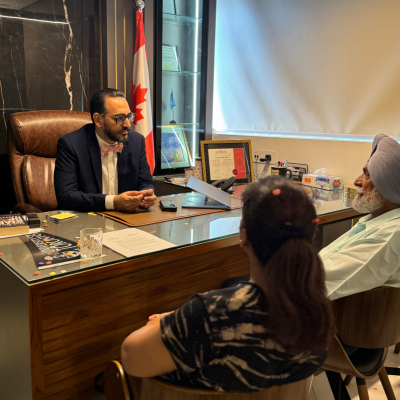
Legal immigration solutions for complex immigration matters
Whether you are applying for permanent residence, planning to study with your family, or bringing loved ones to Canada as visitors, our RCIC-led team provides strategic guidance based on deep experience in Canadian immigration law..


