
Visa Refused?
Get your visa the right way with Richfield.
Understand why your visa was refused and what options are available to you.
Common Reasons for Why Visitor Visa get Refused
Not Satisfied You Will Leave Canada
IRPR Section R179(b)
Purpose of visit is not consistent with a temporary stay.
Lack of Intent to Leave Canada / Weak Home Ties - An officer is not satisfied you will leave Canada at the end of your authorized stay due to weak family, employment, or economic ties to your home country or stronger family/employment ties to Canada.
Unclear Purpose of Travel
IRPR Section R179(b)
An officer is not satisfied that the visit is genuine and temporary in nature.
Financial Insufficiency
IRPR Section R179(b) / Section R220
An office is not satisfied that you have the required funds to support your stay and return to your home country.
Misrepresentation Concerns
IRPA Section A40(1)(a)
An applicant may be issued a 5-year ban from Canada if there is inconsistent information across current and past applications.
The consistency of information in your applications in one of the most critical things you can do to avoid this ban.
Incomplete or Inconsistent Documentation
IRPA Section A16(1)
An applicant has not answered truthfully or has not provided all relevant documents requested the application.
Criminality or Medical Inadmissibility
IRPA Section A36 (Criminality) / IRPA Section A38 (Health Grounds)
A applicant is deemed inadmissibile to Canada due to a past criminal record or health conditions.
Common Reasons for Why Study Visa Get Refused
Financial Insufficiency
IRPR Section R179(b) / Section R220
Requires proof of sufficient funds to support your studies, living expenses and return to your home country.
Study Gap or Career Progression Issues
IRPR Section R216(1)
Requires a credible link between a student's background and the proposed program of study.
Lack of Intent to Leave Canada / Weak Home Ties
IRPR Section R179(b)
An officer is not satisfied you will leave Canada at the end of your authorized stay due to weak family, employment, or economic ties to your home country.
Unclear Purpose of Travel
IRPR Section R179(b)
Officer must be satisfied the visit is genuine and temporary in nature.
A Visa Refusal Is Not The End Of The Journey Case Study:
How Richfield helped an applicant with 6 visa refusals
When this study visa applicant approached Richfield, he had six (6) consecutive refusals. His profile had a critical complication: a re-appear in a core subject in Grade 12th. Every consultant he’d met before treated it as a dead end. Their advice was always the same: give up on Canada and look at another country. This is where Richfield stepped in.
By evaluating his academic history in full, addressing the reappear subject with explanations and additional documentation to prove his genuineness as a student, and building a strategy specifically designed around his complicated profile, we made possible what six previous applications, and every unauthorized consultant before had called impossible.
The Profile:
Applicant with six prior study visa refusals and a reappear in core subject in Grade 12.
The Challenge:
Study Visa refused 6 times repeatedly, and other consultants considered it impossible to fix and advised him to try a different country instead of Canada.
Our Solution:
Our RCIC evaluated the case in detail, identified the real gap that previous applications had failed to address, and built a new strategy tailored to the applicant’s actual academic history, guiding him through each step with full transparency.
The Result:
Visa Approved. After six refusals and years of being told his case was unworkable, a carefully rebuilt application turned his lost hope into a successful Canadian Study Visa.

Client Review
Inderpreet Singh
What Options are available to you after a visa refusal?
Based on the specifics of your refusal, the following paths may be available to you:
- Apply for a reconsideration of the application
If a visa officer has made a mistake in assessing your application, a “Request for Reconsideration” of the decision can be submitted to the visa office. Remember that visa officers will not consider any new evidence through this process and there is no obligation on IRCC to review reconsideration requests.
Reconsideration should be only be done when you are fairly confident that the visa officer has made a mistake in the assessment of certain facts in your application. If you submit reconsideration requests without a valid reason, it may have a negative impact on the credibility of your future applications.
If the reconsideration request is processed, the officer will review the application previously submitted to see if an error in assessment was made. A reconsideration may result in an approval, or may stick with the refusal. - Re-apply for your visa
If you have missed important documentary evidence to support your application and your application was refused for that reason, hire a regulated RCIC and re-submit a fresh application for your visa with new documents. - Appeal to the Federal Court
If, after multiple applications and after submitting everything that the visa officer needs to review the case, your application is still being refused by IRCC, it may be possible to apply for a review of the process at the Federal Court of Canada.
Remember that if you are inside Canada, you will generally have 15 days after your application refusal to submit an application for leave in the Federal Court. If you are outside Canada, you will generally get 60 days to submit the same application.
Who should you hire?
The first thing you should do is not work with an unauthorized agent. Working with an unauthorized agent significantly increases your chances of a misrepresentation ban under section A40. Instead of getting out of your refusal situation, you may end up in deeper trouble.
Instead, hire an expert RCIC who has experience and education in Canada, knows the Canadian Immigration and Refugee Protection Act (IRPA) requirements, has experience getting refusals overturned and understands your local visa office processing methods to successfully get your visa through a reconsideration or a re-application. We can also help you with appealing at Federal Court if your case warrants so.
At Richfield, our RCIC, Mr. Atamjeet S. Walia, routinely handles cases with multiple refusals and has a very high success rate. Most of the clients that come to us believe that going to Canada may not be in their destiny. We have helped 100s of such clients, no matter 1 refusal or 10 refusals, get their visa.
We are confident that we can help you get your visa and help you keep the dream of going to Canada alive.
Our success rates speak for our processes and our expertise.
What we do to get your Visa Approved
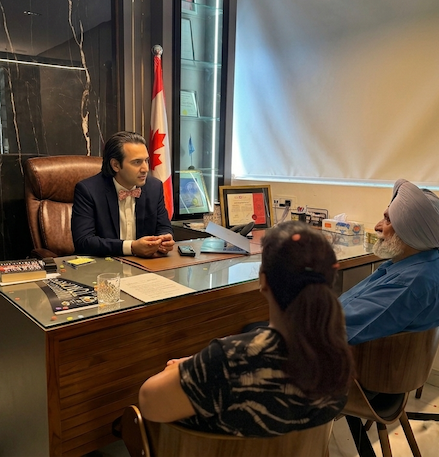
What we do at Richfield to get your Visa Approved
Each refusal results from a unique problem. We care about solving that problem.
- We review your full case history, not just the current refusal.
- We review your full previous application before recommending next steps.
- Every application is assessed by a licensed RCIC.
- We spend the time on legal research that complex cases need, and we do it right for you.
We have decades of experience in Canadian immigration and look forward to helping you.
Frequently Asked Questions (FAQs)
We are living in the “Age of Misinformation”. There is plenty of advise available and it is freely thrown around.
Your chances of success directly depend on how much due diligence you do on your end.
Do not blindly trust everything anyone says. Verify the consultant’s track record and reputation.
To protect your interests, check the public reviews, check for immigration licenses, and ask for references from clients who have successfully navigated the complex immigration environment through that consultant.
Yes, you can. In fact, many applicants obtain approval after correcting the objections raised by IRCC.
A refusal does not permanently harm your profile unless you state conflicting facts between multiple applications.
It is recommended that you first have a consultation with an expert RCIC before you reapply, because there may be issues in your applications that need to be resolved before submitting a new application.
The RCIC will review your ODNs and your previous applications and advise you on how to get your next application approved.
There is no mandatory waiting period, but you must first fix the errors and improve your application before reapplying. There is no value in reapplying quickly with the same documents.
Most Canada study visa refusals from India come down to three things:
The officer wasn’t convinced you’d return after graduation
Your finances didn’t clearly cover tuition and living costs
Your SOP was not convincing enough or was just a copy-paste of 1000s of generic SOPs. Having an expert’s input in an SOP is worth its weight in gold.
Weak academic documents and gaps in your study history also play a role.